
Asbestos Justice has recently settled a complex asbestos claim for a client who was diagnosed with mesothelioma after undergoing a pleural biopsy procedure during February of 2013.
We were initially approached by Mr B in May of 2011 to pursue an asbestos claim for his diagnosed asbestos related pleural plaques but as he was not suffering with any symptoms at that time, no compensation was available as asymptomatic plaques are not currently seen as being compensatable in England and Wales.
Mr B has resided out in France since 1981 and was diagnosed with incurable mesothelioma there. We were able to run his claim by keeping in regular contact by phone and email and this is one of many asbestos claims we have dealt with for clients based abroad.
The claim
Mesothelioma is treated as an indivisible condition in law, meaning that if it is shown that one party materially contributed to the risk of the development of the mesothelioma, then that party will be responsible for paying 100% of the asbestos claim compensation to a Claimant.
In this case the claim could only be brought against one party, namely, HM Prison Service/The Ministry of Justice whom we argued employed Mr B during the course of the time he spent at Her Majesty’s pleasure at St John’s School for boys, Tiffield for approximately 15 months between 1957 and 1960. Mr B was exposed to asbestos with other later employers but no asbestos claim could be pursued against these defunct entities as no employer’s liability insurance could be traced for the small outfits.
Mr B explained that he was not exposed to asbestos for the first 18 months or during the last 3 months of his time at the school. This left a period of 15 months of continuous asbestos exposure to be considered for the purposes of his asbestos claim.
Mr B alleged that he was employed for tuck money at the school to maintain, clean and stoke the school’s coal boiler. It was an old boiler which had an asbestos jacket on it. The pipework leading from the boiler was also lagged with asbestos insulation. All pupils like Mr B were given employment roles as part of their stay at her Majesty’s pleasure.
Mr B provided vivid details of the nature of his exposure to asbestos. He was able to say that the jacket and insulation around the pipework was formed from asbestos as this was a material that he regularly encountered throughout his later career as a fully qualified plumber.
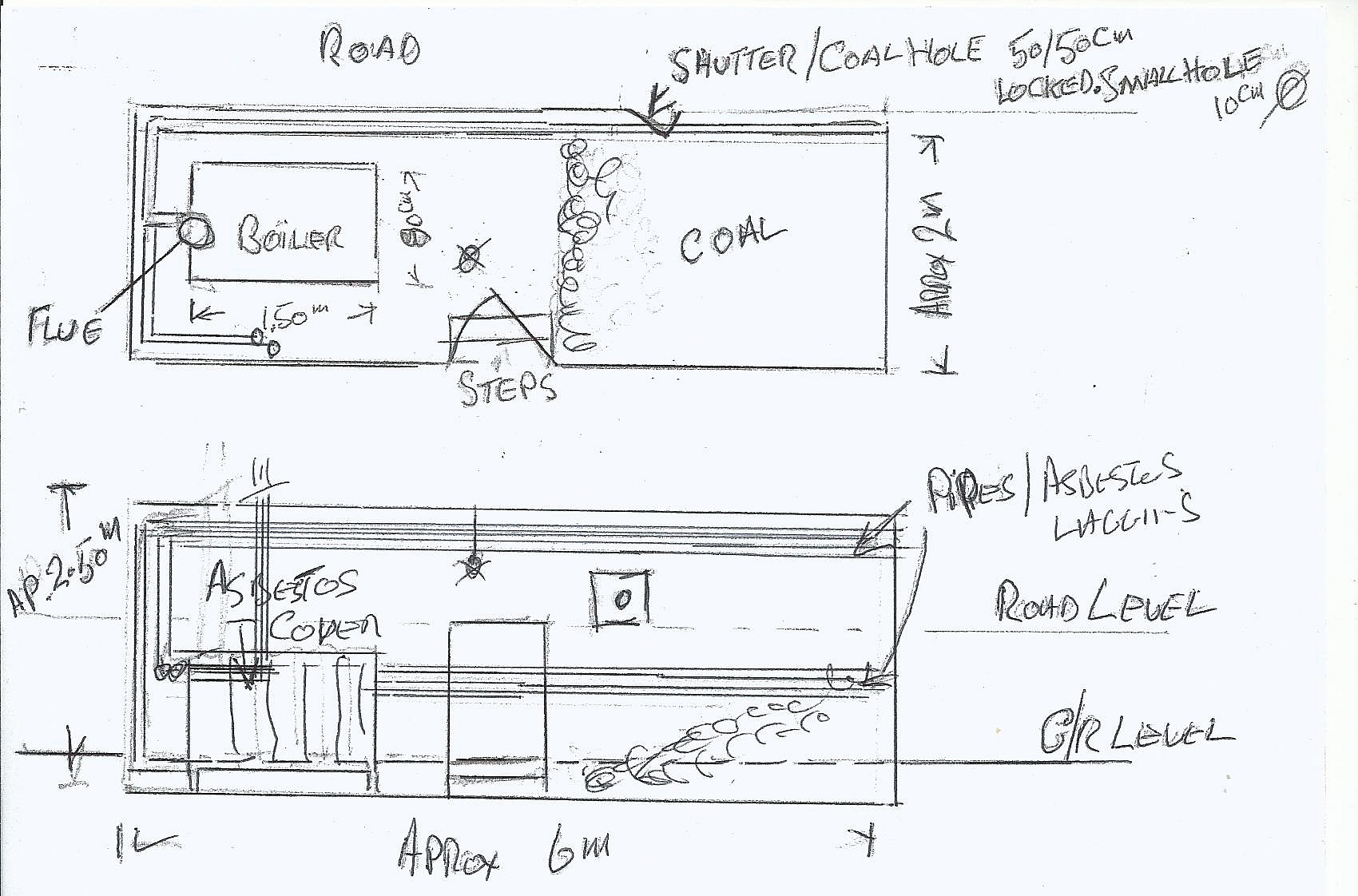
The boiler was present within what he described as a small dungeon type room measuring approximately 6 metres in length with a height of around 2 and a half metres and a width of around 2 metres. The room was extremely old and Mr B believed the boiler to have been a “Robin Hood” cast iron boiler.
The boiler would go out at night and he would receive his morning call at 6am from whoever was on dorm duty to get up to do his work in the boiler room. This would need to be done to ensure the washroom had hot water for the other pupils in the morning.
Mr B provided evidence on the size of the boiler, explaining that this measured around 80 centimetres in width by around 150 centimetres in length. There was just enough room around each side of the boiler for him to fit around to clean the floor and he described the whole atmosphere in the boiler room as being very cramped and uncomfortable.
He also explained that there was a coal hole on the right hand side of the boiler with a shutter attached. Coal could be passed through this hole to be used for stoking. Sometimes lads would pass cigarettes through the hole to him and a beam of light would lead from the hole, especially when it was sunny outside. Some natural light would fill the room as a result along with further light from the flames of the boiler itself. The light was particularly bright whenever he left the door of the boiler open. There was also one light bulb positioned above the entrance door which shed further light into the room.
The presence of some light within the room was vital to the prospects of succeeding in the asbestos claim as when the beams shone through, Mr B was able to see dust particles floating around in the boiler room. Such evidence proved to be vital in securing the mesothelioma compensation.
When working in the room itself, he stoked the boiler first thing in the morning and he then went to classes for about an hour and returned to stoke the boiler again. After lunch hestoked the boiler again and then for a final time at around 8:00pm. It took approximately 1 hour to stoke the boiler each time. He would then have to rake out the ashes, shovel in coal and then sweep the boiler room.
Due to the age of the boiler and pipework, Mr B described the lagging as being in a very poor state of repair. He explained that he would regularly brush past the asbestos jacket which covered the boiler as well as the pipes leading from it which were also lagged with the asbestos.
The asbestos jacket was formed out of the same typed of asbestos present on the pipework. It was loose and in a terrible state and was not held into place around the boiler properly. The straps which should have held the jacket into place were so heavily rusted that parts of the metal strap were not even there. This resulted in the jacket being loose as a result of failing to be fixed into place properly.
He recalled the lagging which formed the jacket measuring around 1 to 1 and a half inches in thickness when he first started work in the boiler room. The thickness gradually decreased over time. It was not in the same form as actual asbestos jackets he witnessed later on during the course of his time working as a plumber. The more solid blanket type insulation materials were only introduced to wrap around boilers much later on during the late 1960’s according to Mr. B.
Helpfully, Mr B was able to draw a sketch plan of the boiler room to paint a picture of the area where he suffered his asbestos exposure at the school and this was provided to the solicitors for HM Prison Service/The Ministry of Defence in support of his claim for mesothelioma compensation.
The dustiest work involving the asbestos involved the times he would have to brush past the asbestos jacket on the boiler in order to sweep around. As he did this, he stated that it was common for chunks of the asbestos lagging to fall down upon him and he could not help but breathe in the harmful fibres. It was an extremely hot and cramped environment and there was nowhere for the disturbed asbestos fibres to escape.
If there were any sections of the asbestos lagging dangling from the pipes or jacket he would simply rip them off to be placed on top of the boiler to be cleared away at the end of the day. He would clear the pieces of asbestos lagging by placing the pieces back under the rusty metal straps to be put back into place as best he could. Mr B stated that it was impossible to replenish all of the asbestos lagging as some of this had broken down into dust particles on the floor and gradually over time the amount of asbestos present in the form of the jacket and insulation around the pipework diminished over time.
He remembered the asbestos insulation in the form of the jacket and pipework insulation being a very brittle material which was of a whitish colouration and looked extremely old, similar to a fibrous form of plaster of Paris to look at.
He explained that he swept the floor to clear up the asbestos dust with a fixed broom. As he did this the dust rose up in the air which included coal and asbestos dust and he could not help but inhale it. He did this every morning, every lunch time and every night for approximately 15 months solid. Due to the beams of the light within the room he could see different types of dust floating around in the general atmosphere which included the asbestos dust. He recalled this looking different to coal dust which was darker. He described the asbestos dust as having an almost glittering appearance to the eye.
As with any asbestos claim, we took detailed information from Mr B covering the amount of time he spent being exposed to the airborne asbestos dust. He estimated that he spent around 45 minutes of his working day sweeping up the boiler room. On each occasion he swept up the dust which included coal and asbestos dust, this would take around 15 minutes. He also spent around 15 minutes during the morning, dinner and evening work sessions taking a bit of a break in the boiler room.
He would usually do this after the boiler was fully stoked. He would complete the sweeping after taking these breaks. This would involve sweeping up all of the dust including the coal dust and asbestos pieces and dust which he would then shovel back into boiler when fully up and running.
Mr B advised that he would be covered form head to toe in all forms of dust including the asbestos dust at the end of each day and would continually inhale this when returning to his dorm.
He also explained that his work was checked 2 or 3 times a day by the school’s headmaster and house-master and despite this, he explained that he was never warned of the dangers of being exposed to asbestos dust throughout the course of period of employment with the school.
Denial of liability
Mr B’s witness statement referring to his detailed account of his asbestos exposure was provided to the solicitors for HM Prison Service/The Ministry of Justice in support of the complex asbestos claim.
The Defendant initially refused to admit liability on the basis that they did not feel that the tasks carried out by Mr B at the approved school for boys would amount to “paid employment” in law. They contended that the employer’s liability legislation relied upon when arguing liability, would not be relevant in this case. They believed that the only relevant Act that that would apply would be the Occupier’s Liability Act of 1957.
Further, the Defendant did not accept that Mr B had demonstrated any breach of duty, particularly by reference to the level of knowledge about the risk of mesothelioma as a result of Mr B’s asbestos exposure in the 1950’s.
Further evidence needed
When receiving details of a denial of liability on such grounds in this type of asbestos claim, we have to look to obtain further evidence to support the claim for mesothelioma compensation.
It is well known to specialist asbestos disease solicitors like ourselves that prior to the publication in the Sunday Times of Newhouse and Thompson’s October 1965 article, which covered the dangers of developing mesothelioma after being exposed to minimal quantities of asbestos, Claimants usually have to show that they were exposed to substantial quantities of asbestos dust in their work. Earlier dates of knowledge apply for certain employers but this is the generally accepted rule. After 1965, lower levels of asbestos exposure were known to be dangerous.
In this case, the further evidence required took the form of expert engineering evidence. The Engineer’s duty is to the court and he became involved to assist the judge in understanding whether Mr B was
- exposed to substantial quantities of asbestos dust and
- his total asbestos dust dosage when working for the Defendant when compared to his other periods of employment as a plumber
Thankfully, the report was provided by the Engineer confirming that such exposure was substantial by the standards of the day in his opinion and importantly he added that the exposure amounted to 4% of Mr B’s overall period of exposure to asbestos dust. In order to establish medical causation in a mesothelioma claim there is a need to show that the exposure exceeded 1% of the total dose. Clearly, this had been exceeded in the opinion of the expert based on the facts of what can only be described as a novel asbestos claim.
We then proceeded to obtain expert medical evidence from a well respected Respiratory Physician to further support the claim for Mr B’s mesothelioma compensation and this confirmed that the exposure levels referred to in the engineering evidence were sufficient to have materially contributed to the risk of Mr B developing his incurable asbestos related mesothelioma.
We also maintained our strong view that clearly, Mr B was remunerated for his working role when residing at the school and therefore employment was established.
The completed evidential package was forwarded to the Defendant’s solicitors who failed to make any offers to settle the asbestos claim within a reasonable period of time and, therefore, court proceedings had to be issued under the High Court’s specialist asbestos claim procedure in London.
With the threat of the costs of the asbestos claim increasing following the issuing of proceedings, the Defendant eventually decided to make Mr B an offer to settle his claim for £120,000.00 in full and final settlement which he was happy to accept.
This case shows that even when Claimants suffered asbestos exposure prior to 1965 it is still possible to recover mesothelioma compensation, providing it is shown that they suffered substantial exposure by the standards of the day. Success would also depend upon whether the exposure alleged equated to a figure in excess of 1% of the sufferer’s total dose of asbestos dust exposure.
Mr B was naturally delighted with the result in his case and we are pleased to say that he has received excellent treatment and care in France where he resides. He has undergone 4 full cycles of chemotherapy treatment since being diagnosed with his condition back in February of 2013 and explains that the asbestos compensation he has received will now assist him and his family in the future.